

Recently, I joined the Pentecostal church, and one thing almost everyone associates with Pentecostal Christianity is spiritual expression, especially speaking in tongues. Naturally, I became curious, not to criticize it, but simply to understand it more deeply. So I began studying Scripture to know more. Then one morning, in the middle of that desire, a quiet question rose within me: Before you speak, do you have the fruit of the Spirit? I remember pausing immediately because if I am honest, I was expecting an experience, but instead, God gave me a question.
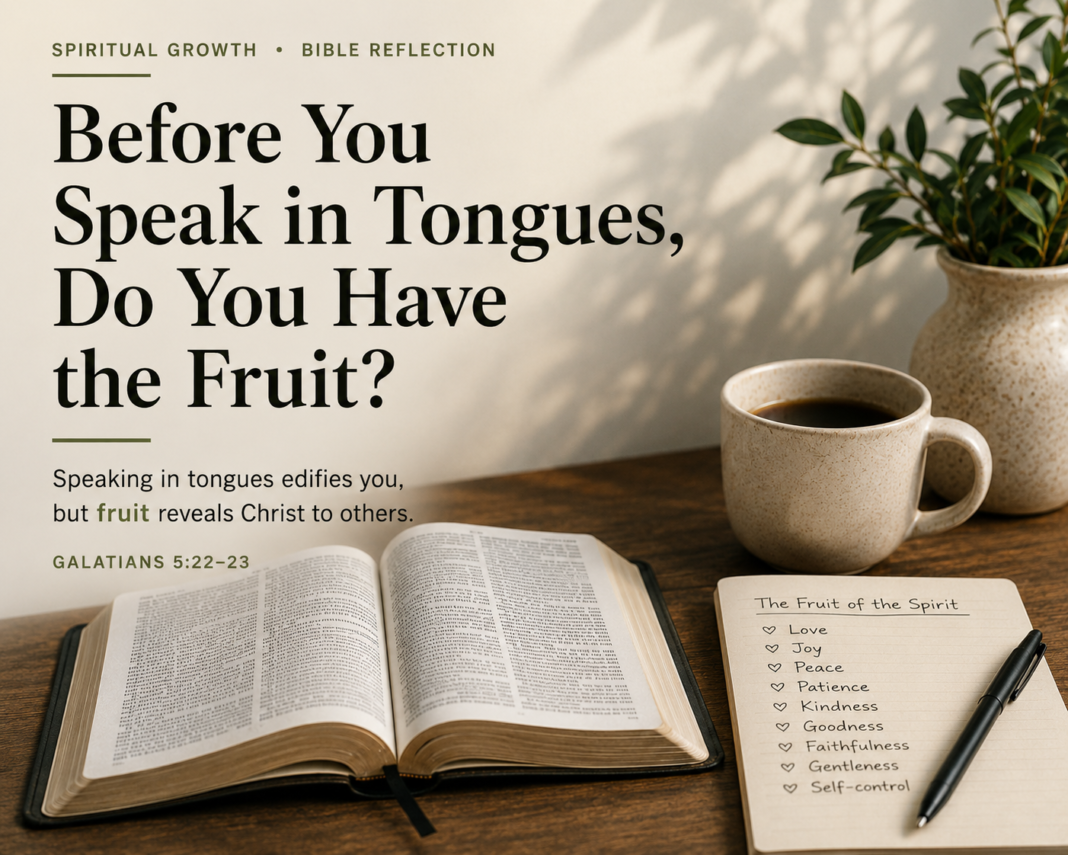
That question eventually led me to Galatians 5:22–23: “But the fruit of the Spirit is love, joy, peace, long suffering, kindness, goodness,faithfulness, gentleness, self-control. For the first time, I stopped asking myself, “What spiritual gifts do I desire?” and started asking, Is there evidence that Christ is genuinely changing me? Those questions humbled me deeply because it is entirely possible to pursue spiritual experiences whilst neglecting spiritual transformation.
Now let me be clear: this article is not against speaking in tongues. Scripture itself says in 1 Corinthians 14:4: And “He who speaks in a tongue edifies himself.” But Scripture also reveals something important that I do not think we should overlook: speaking in tongues edifies you, whilst fruit reveals Christ to others. A person can sound spiritual and still struggle with gentleness. They can pray loudly and still lack kindness. They can know Scripture and still be deeply impatient. But fruit is different. Fruit appears in ordinary life, not merely during worship services, conferences, or prayer meetings. Fruit shows up in traffic, in conflict, in disappointment, in correction, in seasons of waiting, and in moments where nobody is applauding you.
And honestly, I think this is why Jesus said: “By their fruits you will know them.” Matthew 7:20. Jesus did not say by their tongues. He said by their fruits which are; love, joy, peace, patience, kindness, goodness, faithfulness, gentleness, and self-control.
These are not optional Christian qualities. They are evidence of a transformed life. The Holy Spirit’s question to me that morning was not condemnation. It was an invitation. An invitation to care not only about what comes out of my mouth, but also about what is growing within my heart. And perhaps that is the question some of us need to sit with too: before we pursue greater spiritual expression, what is our life producing? Not perfectly, because none of us are perfect. But is the fruit growing? Is it visible? Is it something we are intentionally cultivating? Because perhaps the world is not waiting for louder Christians. It is waiting for Christians who genuinely reflect Christ. And perhaps the greatest evidence of the Holy Spirit is not always what we say in church, but who we become outside of it.